
Polymarket is one of the biggest US prediction market sites, and thrives with massive liquidity, trading features, and relatively low fees. It is something of a stalwart in the industry, and really came to mainstream prominence during the 2024 US Election cycle, where Polymarket beat all the other prediction markets and recorded over $3.3 billion in trading volume. The operator left the US in 2022, but returned in 2025 through Polymarket US. Right now, Polymarket is legal in the US, and while the site is still in Beta phase, you can sign up to it, deposit USD, and make trades.
People who use Polymarket US generally look for the following things:
- Contract trading (prediction market-style trading)
- Trading with both maker and taker features
- Low trading fees
- Designated mobile apps
Polymarket isn’t the only platform that delivers these. There are plenty of alternatives that have similar offerings, with their own special trading features and dedicated communities. On this page, our experts have rounded up the best sites like Polymarket.

Best Sites Like Polymarket
To make our shortlist for the best alternatives to Polymarket, we selected prediction markets with similarly high market volume, sports coverage, and trading features. In the following mini-reviews, we detail the similarities between the selected sites and Polymarket, and if you want to learn more about any of them you can check out our full reviews.










#1. Kalshi
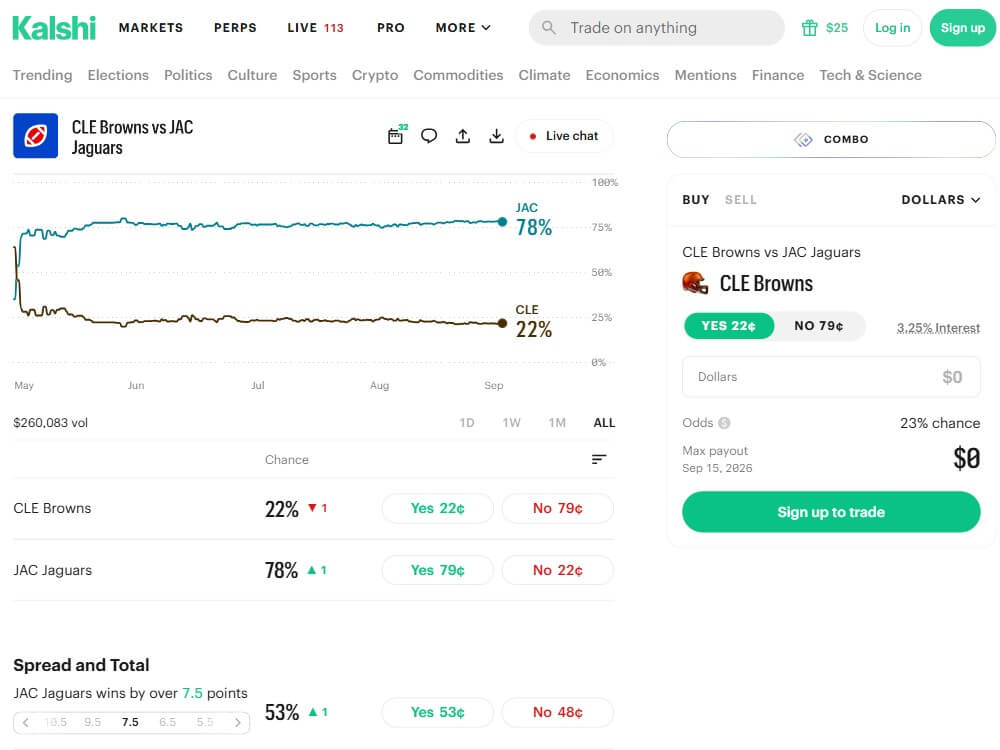
This shouldn’t be a surprise. Kalshi and Polymarket are like the FanDuel and DraftKings of prediction markets. It is perhaps the most well known prediction market in America. There is a popular belief that Kalshi is #1 for sports trading and Polymarket is #1 for political contracts. But the truth is that both have a diverse range of categories and while over two thirds of the volume at Kalshi is on sports, it is by no means a sports-only prediction market.
It also has politics, finance, culture, and even perpetual futures (Kalshi Perps). The sports offering here is really second to none. Kalshi was the first prediction market to offer parlay style trades, and it definitely has the depth. You can find single games or tournaments with hundreds of different contracts, spanning player props, game lines, alternate lines and so much more. The only thing that turns some away from Kalshi are the high taker fee commissions. These are variable rates (like Polymarket, they depend on the contract price/percentage), and can go up as high as 7%.
Kalshi Pros:
- Parlay trading and SGPs
- Unrivaled sports coverage and market depth
- Chat and social features
- Comprehensive market data
Kalshi Cons:
- High taker trading fees
#2. Plus500
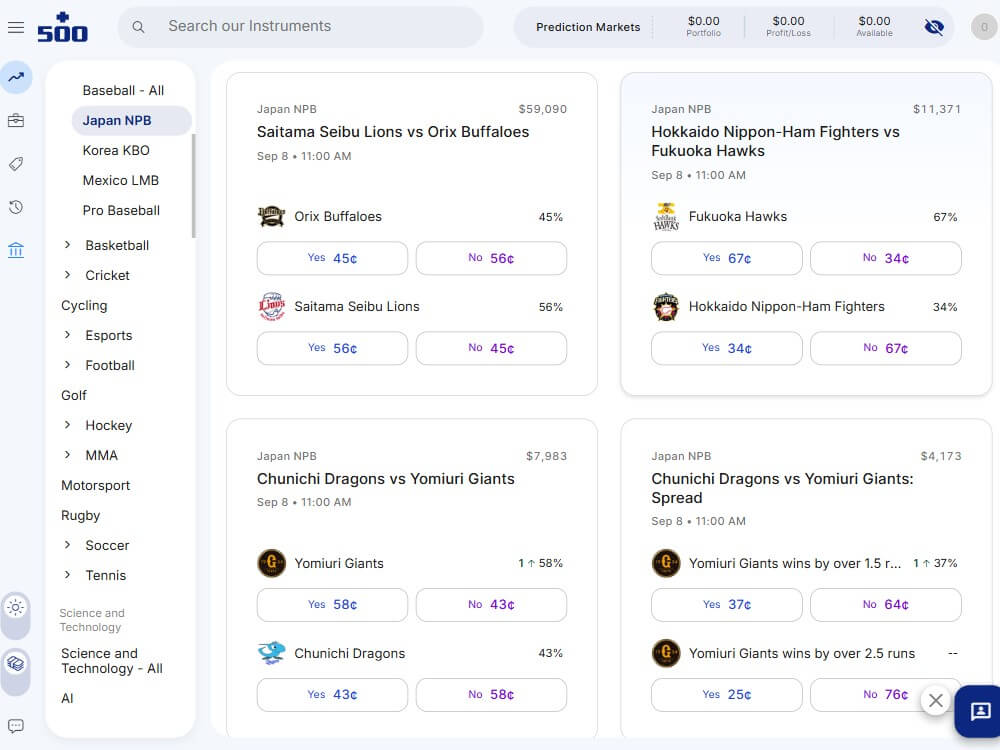
Like Polymarket, Plus500 has an excess of liquidity, has high performance mobile apps, and covers niche sports too. Plus500 is also a trading app, with stock options, ETFs and bonds. You can toggle between financial options and prediction markets, which is a pretty unique function. Within the prediction markets, Plus500 has a strong offering in different sports, but the market depth for single events or tournaments can sometimes be a little limited. Another drawback is that Plus500 doesn’t support Make Orders, which you can get at Polymarket.
We think this platform is very well suited to value bettors and high rollers alike. Value bettors for its lenient flat fee schedule, so you don’t pay more because the odds are closer to even money – like at Kalshi or Polymarket. Also, the ceiling on orders and deposits/withdrawals is set nice and high, so high rollers can take full advantage of those fixed fee contracts and squeeze out high value.
Plus500 Pros:
- Flat fee schedule
- Financial trading and prediction market in one
- iOS and Android apps
Plus500 Cons:
- Market depth can be limited
- No parlays
#3. Novig
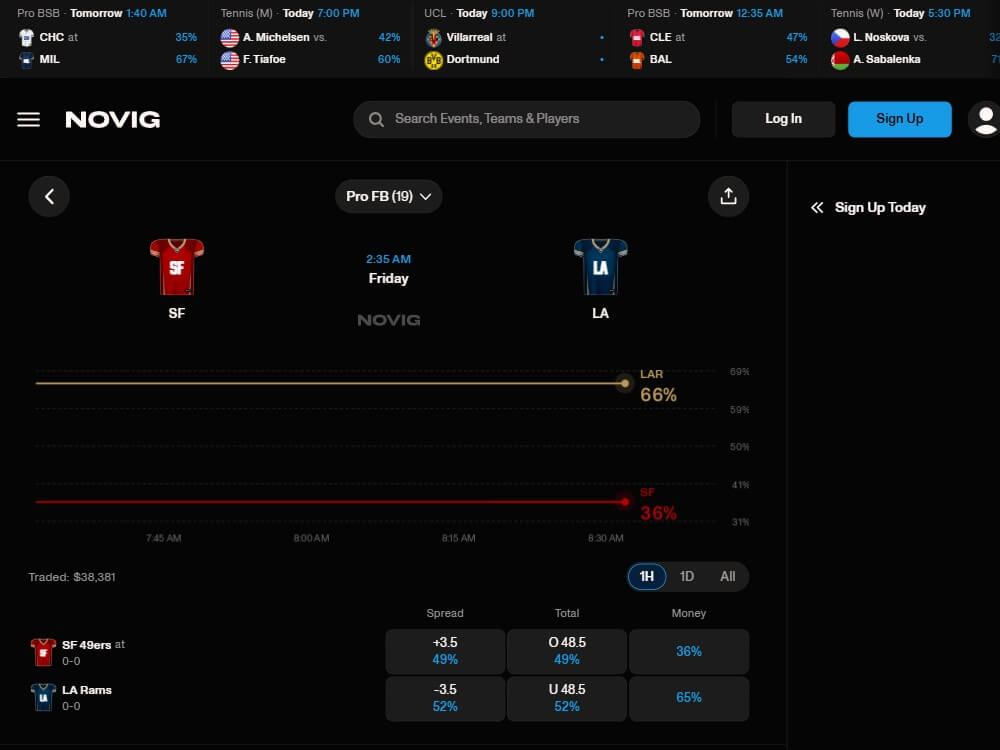
Novig was originally a peer to peer fantasy platform that used sweepstakes mechanics to give predictions. In the summer of 2026, Novig obtained a DCM license and then it transformed the sweepstakes sportsbook setup for a prediction market. What makes Novig intriguing for sports fans is that some of those highly coveted P2P functionalities have been kept, and combined with the prediction market analytics, this is a good option for sports fans seeking betting-style contracts.
The sports coverage is vast, with plenty of alternate lines and props, just like Polymarket. However, Novig goes a bit further, with options to build parlays and SGPs, you can just combine trades in the Trade Slip and then see how it impacts the contract prices/percentages. Novig supports make and take orders, has no fees on maker trades but taker contracts can fetch slightly higher fees (it depends on the contract price – like at Polymarket). Other key features are the Novig early payout, trade tracking features and the excellent loyalty program.
Novig Pros:
- Parlays, SGP and early payout features
- Excellent P2P functions for make and take orders
- Loyalty program
- Trade tracker
Novig Cons:
- Scalable fees can be high on taker orders
- Some deposits carry 3% fees
#4. OG
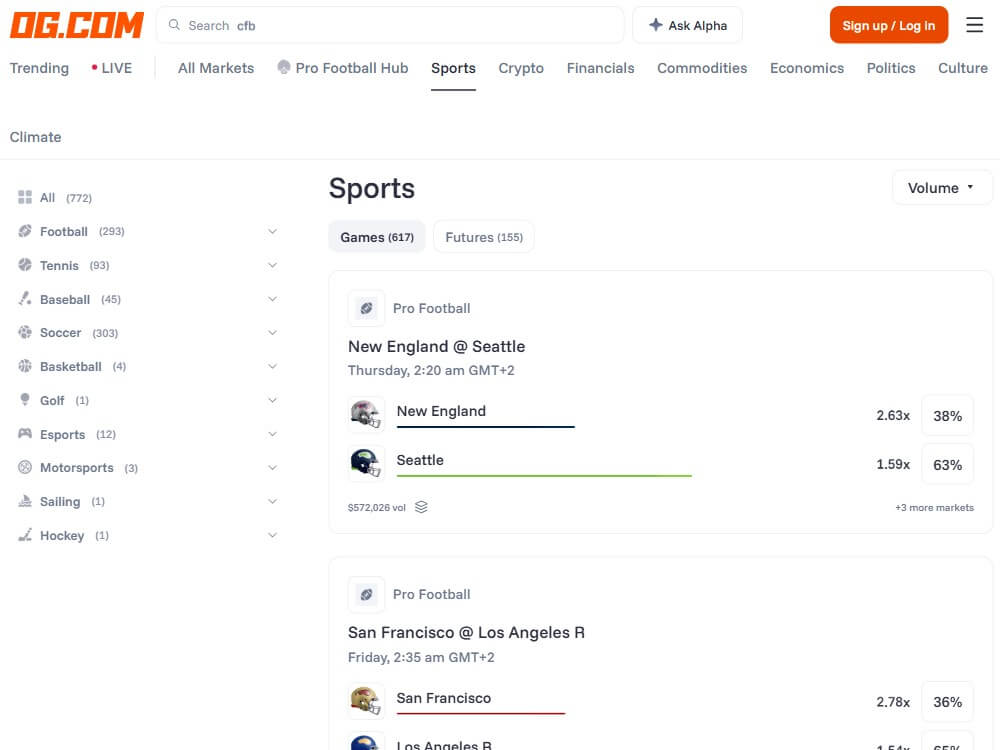
OG.com has a sports-first catalog of markets, with trading rewards, parlay options and crypto support – all the things that people interested in Polymarket are looking for. While it doesn’t have as many niche sports as Polymarket, OG goes into depth with the sports it does cover (major US sports, college sports, soccer, golf, tennis, etc), and it has a considerable range of spreads, totals and props. OG has parlay trading options, but when we tested these we found out that they aren’t as varied as, say, Kalshi.
Fees are fixed, you have to pay for opening and closing contracts early, but positions that settle carry no extra fees. OG sets a maximum 2,500,000 contracts on a single position, which is a tall ceiling for the high rollers, and for the lower budget traders, the withdrawals have a minimum limit of just $1. Throw in a variety of loyalty perks including boosts and reward credits, and OG gives you plenty to consider.
OG Pros:
- Parlay and SGP options
- Loyalty rewards
- Fixed fee schedule
- Supports crypto
OG Cons:
- Limits in parlay trades
- Market volume data is not as detailed
- Fewer sports covered
#5. ProphetX
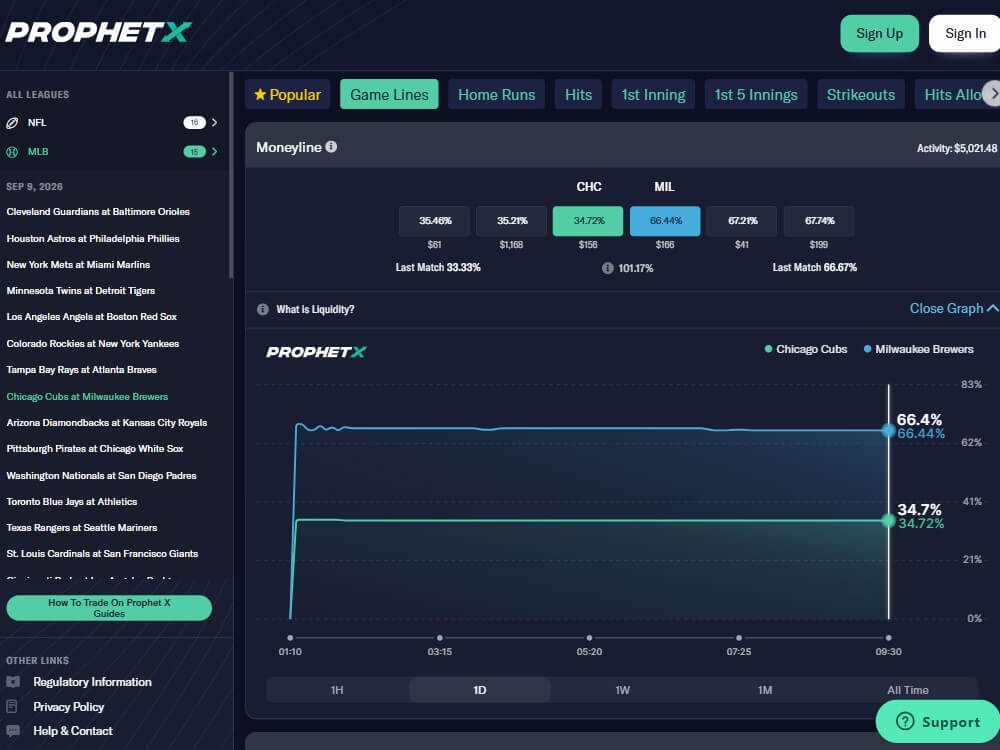
ProphetX is another former P2P sweepstakes betting site that converted into a prediction market. This prediction market may not have the same depth of sports coverage as Polymarket US, but it has quality peer trading features that expert value bettors can really capitalize on. Instead of just showing market volume or line movements, you also get data relating to the market overround and the liquidity for alternate prices on the same contract. You can also create your own orders, set time limits for resting positions that fully or partially auto-cancels the order.
The P2P trading functions are very well thought-out and ProphetX charges a 2% fixed commission on straight trades and nothing on parlays. With a depth of props, totals, alternate lines and futures to pick from, ProphetX is a very good alternative to Polymarket. The only downsides are that the platform doesn’t have many payment methods and it could have more sports categories.
ProphetX Pros:
- Expert peer to peer trading features
- Volume and price analytics for value trading
- Live trades and parlay options
ProphetX Cons:
- Fewer sports covered
- Limited payment options
How to Pick a Prediction Market
A prediction market is a site that offers binary contracts on real world events, which you can buy at current prices and then either leave to settle or cash out early. They all follow these universal principles, but there are key differences in the sports/markets they cover, the features around this setup, the fee schedules, and any associated rewards or perks. When choosing a prediction market, you have to factor all of these conditions into your decision.
- Sports variety: How many sports a prediction market covers. Some may focus only on major US sports, whereas others may have broader coverage but omit key sports like soccer or tennis
- Market depth: Main markets, props, player props, alternate line markets, futures and live trading are all examples of the types of markets you can get for single games or events
- Market analytics: How much data the platform shows you on single Yes/No contracts (liquidity, trading volume, accuracy of line movements, and other important insights)
- Make/Take order functions: Taker orders are commonly offered, but not many platforms support make orders where you set your own price and leave an open position for another trader to fill/take
- Fee schedule: The rules on commissions/fees vary by platform, commonly they are either flat rates or variable fees (the latter varies depending on the price/percentage per contract)
- Parlay/Combinations: Not all platforms support parlays or SGP trades. Those that do may still have limitations on what types of contracts you can combine into one order
- Mobile functionality: Check for mobile functionality/if the platform has native iOS or Android apps. It should cover access to market data, expert trading functions, any associated rewards and payment management
- Settlement rules: How settlement works, are there conditions for early settlement/cashout and when operators may void/nullify open trades
- Payments: Types of payment methods supported, minimum/maximum limits, whether or not there are fees for deposits/withdrawals
Think about your budget, your market preferences and what kind of strategy you want to use. These are going to help you filter the options and pick out a prediction market that does the job.
Strategies for Using Sites Like Polymarket
Because there are many strategies that you can employ in prediction markets. The most common is value betting. Prediction markets give you plenty of data, and the prices for the contracts are directly impacted by market demand. At the top sites, this means quicker and more precise fluctuations in the price, and if your prediction market supports futures or opens markets early, bettors who hunt value will have plenty of time to analyze the movements and find the best time to strike.
The prediction markets that support live trading add an extra layer to that. It can be a lot more volatile, but the dynamic shifts in the prices can open excellent opportunities for value bettors. Of course, for live trading you should be careful not to leave any positions open (no maker orders), be ready to trigger early settlement, don’t overspend, and pick a prediction market that doesn’t have excessively high taker contract fees.
Hedging is another popular strategy at prediction markets, and some platforms allow you to take positions on either side of a contract. Given the sudden and dramatic line movements, it can expose very high ROI opportunities for arbitrage bettors. This is a high-risk strategy, especially when market volume is very small (and buying contracts can make massive movements), or in hyped up markets where public opinion alternates drastically.
Ultimately, the prediction market you choose should fit into your strategy and provide you with the responsible trading tools you need to control your spending.
