
Prediction markets offer a very different style of betting to traditional sportsbooks, social sportsbooks and DFS apps. It is closer to peer to peer betting exchanges, but prediction markets really fall into a category of their own, with unique trading features, market analytics, and pricing dynamics.
Another point is that the offering at different prediction markets can vary, from the depth of markets to the way they charge commissions or fees for your trades. Each site has its own strengths, and the best way to measure these is by directly comparing them with other prediction markets. The space is a lot younger than traditional sportsbooks and fantasy apps, and there are nowhere near as many prediction markets. But, new sites emerge quickly, and the technology also moves on swiftly, so to stay ahead of the curb, comparisons are actually an ideal way to pick out the best prediction markets right now.
Best Alternative Prediction Market Comparisons
Below are our direct comparison pages. If you are tired of using a prediction market and want to try a new one; or can’t decide between 2 or more prediction market sites, these are your ideal references. You can read direct reviews where we compare the top prediction markets against their competitors.






Prediction Market Criteria
The quality of a prediction market can be measured in plenty of different areas – it is not all “more betting markets” or “better bonuses”. These are typically what people look for at classic US sportsbooks, and you can get a pretty good idea of that in our alternative sportsbooks hub. But for prediction markets, the criteria are different.
You aren’t betting against the house but against your fellow traders or the crowd. The approach is very different, as you can find excellent betting value, but you need to be cautious. The best prediction markets give you the tools to capitalize on this P2P trading mechanism, without cutting too much into your profits with fees.
Sports Coverage and Depth
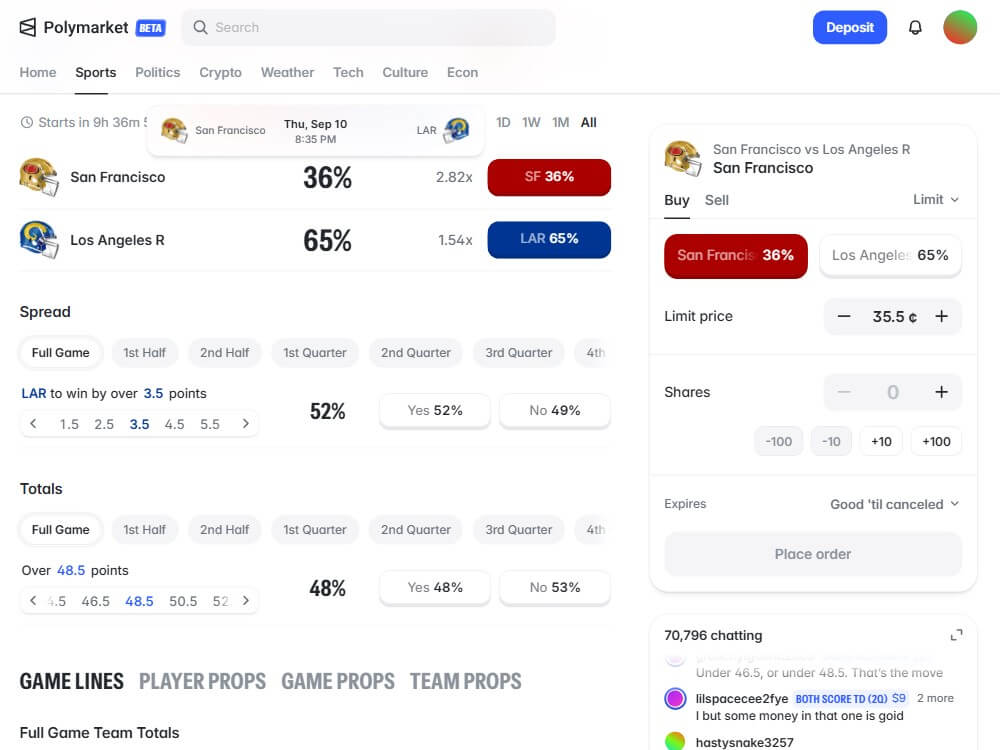
The first thing you can check is the extent to which your favorite sports are covered, this is an area that can vary drastically. Better prediction markets will cover a good 10+ different sports, including the major ones like football, soccer, basketball, baseball, tennis, and golf. Even some of the biggest prediction markets don’t have more than 10 sports categories, so you need to be very careful to check what they have. Then, click on any game within those sports to check what markets they offer on that event.
Because market coverage is another area with varying levels of depth. Some sites just cover main markets, such as game outcome, totals and spreads. Others will extend this a little, with adjustable line totals and spreads, and possibly a handful of player bets and props. Futures are just as common as game outcome markets, and given the long-term nature of these predictions, they generally summon large market volume. Then, for live trading, a lot of prediction markets do this, but it is important to assess the markets offered, the market volume, and how detailed the analytics are.
Parlays and Combo Trades
This is a bit of a rarity at P2P betting exchanges and prediction markets, simply because it requires more liquidity and complex arrangements to settle combo trades. However, top platforms like Kalshi, or traditionally P2P sites like Novig and ProphetX, do have parlay building. If this is something you need in your prediction markets, it will narrow down the list considerably.
Market Volume and Liquidity
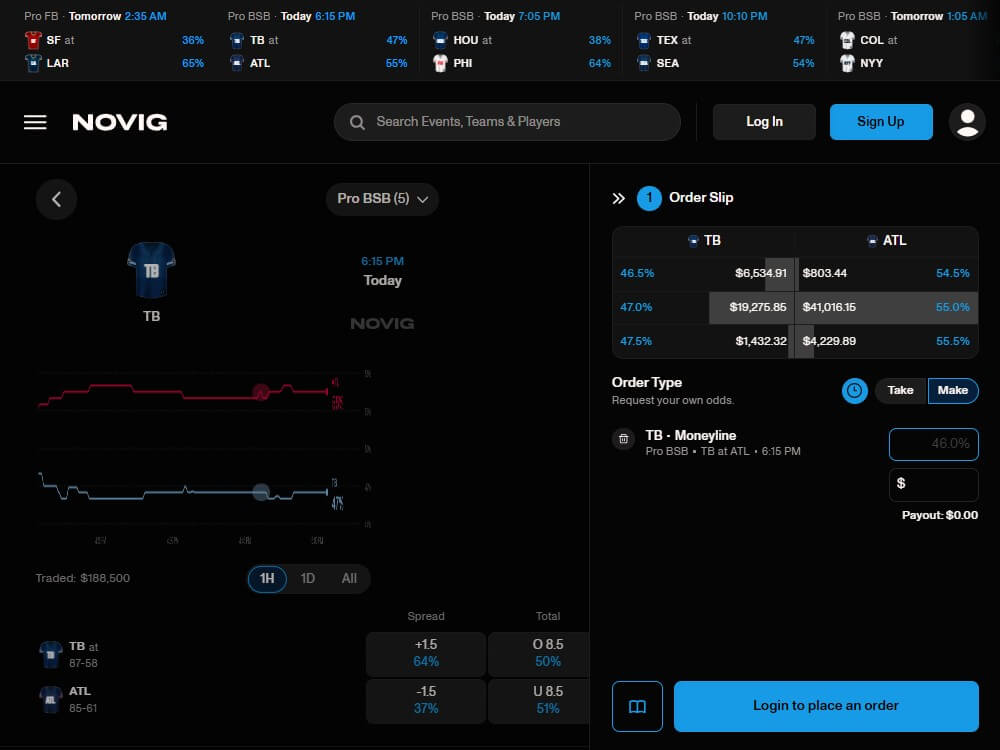
As you are not trading vs the house but against your peers, market volume is critical. If there is no volume, you cannot Take Orders (bet against existing liquidity), and opening positions with Make Orders (set your price, and wait for someone to lay the bet), becomes challenging. You may miss out on certain games simply because there is no one else on that site who is trading one those events. Or, what is more common, you won’t find a buyer to bet against your made order on a specific market.
The more popular prediction markets can even struggle with demand volume for niche games or very specific betting lines/props. Live trading is also more difficult when market volume is lower. More market volume means more liquidity, which means there is money to take positions against and try to win. Newer sites and lesser-known ones tend to struggle to create market volume, so when assessing sites be very careful to check the average volumes, which sports are trending, and how much volume live trades generate.
Prediction Market Betting Features
Prediction markets use a pricing mechanism that is driven by trading demand, and this means the lines can move considerably. Line movements that are not capped by juice or a sportsbook’s odds generating algorithms are really better than the best sharp sportsbooks for value bettors. You get to review the prices in real-time, and the best prediction markets also throw in tools to help you track these movements.
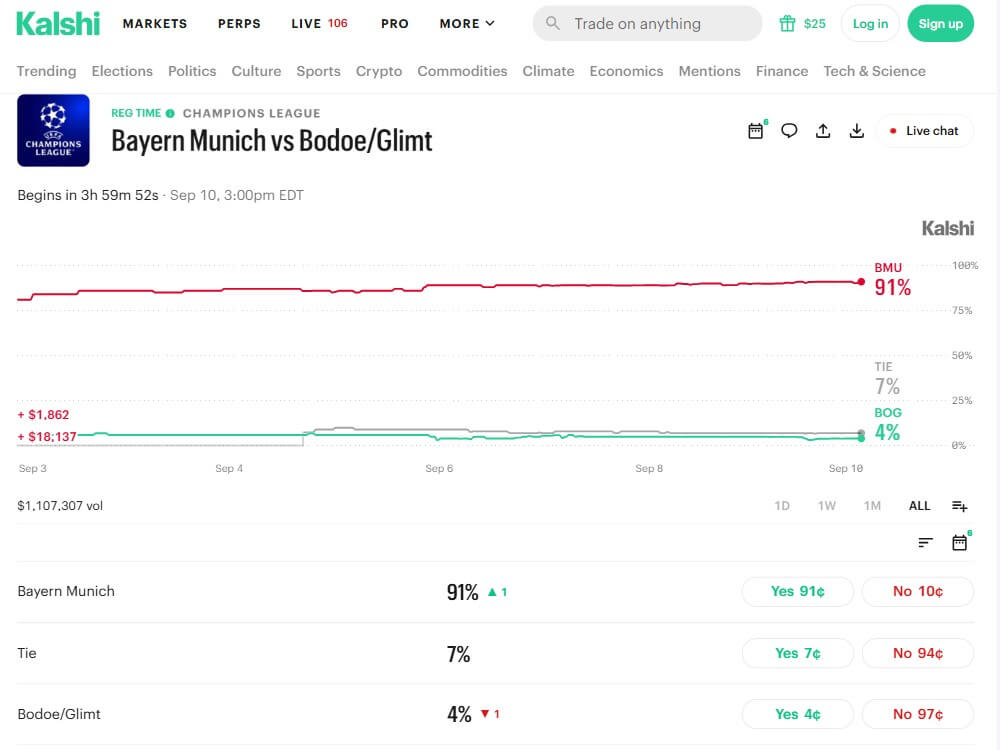
- Market volume ($) data
- Line movement history tables
- Last orders/last trading prices
- Alternate line prices
- Chat boxes
This is key to planning your trades ahead of time, assessing trajectories to predict closing line value, and getting better value for your money. There are also betting tools with steam trackers and line shopping that scan sportsbooks (some even reach to prediction markets too), and these metrics are crucial for picking out higher value.
Fee Schedules
Continuing on the subject of value betting, prediction markets do not charge juice in the prices, these are the rates that your fellow traders are staking their predictions at. But prediction markets do need to make their business, and this is done by creating a fee schedule for event contracts sold. There are two ways to do this:
- Variable fee structure: The fee depends on the price of the contract (the probability of it winning)
- Fixed fee structure: You pay the same fee on a $0.15 contract as a $0.65 contract – the fee is fixed
Variable fees tend to climax at the midway point, around $0.50, where you have a 50% chance of winning. They tend to be lower at the extremities – near $0.01 or up at $0.99. There are pros and cons to both fee structures, and it all depends on whether you are picking out more even money predictions or look for the longshot/strong favorite predictions.
What matters most is how much you pay and when you pay. Usually, you have to pay a fee for take orders (you buy at the given price), but make orders (set your own price) are not charged. If the trade settles, usually you don’t pay extra, but if you close the position early (“cash out”) you may be charged. But this can vary by site.
Payment Methods and Crypto Support
Bank cards, ACH bank transfers and wire transfers are the most commonly supported payment methods at US prediction markets. Some sites just stick to these, but others may delve into popular eWallets, third-party processors like Apple Pay, and offer other gateways.
A major difference between prediction markets and traditional sportsbooks is that they can support crypto payments. Sportsbooks in the US don’t, but these federally regulated trading apps can. So you may get platforms that support Bitcoin, Ethereum, Litecoin, Ripple, and others. If you don’t want to own volatile crypto assets, then you can always look for stablecoins like USDT or USDC, which are pegged to the US Dollar, and don’t fluctuate like Layer-1, Layer-2 tokens, or memecoins.
Just be sure to check if a site has good deposit and withdrawal limits, and if there are any added charges for specific payment methods.
Financial Trading & Non Sports Markets
There are prediction markets that solely offer event contracts on sports, and if that is all you are interested in, they are perfectly ample. But prediction markets in the US can offer contracts on much more, ranging from politics and finance to cultural and even miscellaneous contracts. Between predicting the next Super Bowl winner and making trades on MLB games, you could also dabble in weather markets, contracts on political elections or crypto price movements.
Other categories can include:
- Crypto
- Finance
- Politics
- Weather
- Culture events
- Technology
Prediction markets like Crypto.com or Plus500 also operate as trading platforms where you can buy stocks, trade Forex, and even hold crypto assets. Again, it is not for everyone, but if you want to build a financial portfolio or make predictions on non-sports contracts, just know there are some platforms that accommodate these, whereas others may just stick to sports.
Prediction Markets Rewards and Bonuses
Where sportsbooks offer bonus bets, no-sweat bets, boosts, free to play games and a variety of other promotions, prediction markets generally don’t go to those same levels. You can snap up welcome bonuses at most prediction markets, but existing user bonuses are not very common. Or where they are, you can’t really compare them against sportsbooks – and definitely not against social sportsbooks – that lean heavily into rewards.
The value is in the markets themselves, which don’t have house edges. Though we have reviewed prediction markets with humble bonus offerings, potentially dipping into site credits, integrating blockchain staking rewards, or financial instruments with boosted perks. Our recommendation is to never compare prediction market bonuses to sportsbooks or social sportsbooks.
Your Approach to Trading
When picking a site, think about your strategy and exactly what you want to get out of the prediction market. Value betting is mentioned a lot around prediction markets, and it can definitely become a source for getting better returns on your predictions. Everyone wants value, but there are many ways about getting that value, and exactly how you implement it into your bigger strategy.
With market volume analytics, real-time price movements and Make Order options where you can set your own prices, prediction markets open the doors to many different strategies.
- +EV betting: Use metrics to calculate expected value and find the highest EV percentages
- Line movement tracking: Great for snapping early bird prices and beating CLV
- Arbitrage bets: Open positions on either side of a market (on different sites)
- Dutching (hedging): For markets with more possible outcomes (championship winner, etc), back numerous teams to win
- Sharp betting: Track movements for whale movements and steam, and capitalize on soft books where the odds change later
- Live betting: Take advantage of existing open orders, or open positions of your own at favorable prices
You don’t have to use prediction markets as your single source to place bets. A lot of line shopping betting tools use these to evaluate EV and pick out arbitrage bet pairings against real money sportsbooks. The market demand can also be a good point of reference for finding sharp odds.
Holding Accounts at Multiple Sites
There are no rules against joining multiple prediction markets, or using both prediction markets and sportsbooks. In fact, value bettors can use both, taking data from prediction markets to make smarter bets at sportsbooks, hedge their sportsbook bets at prediction markets, or compare value by taking metrics from both.
It is free to sign up to prediction markets, they don’t really give you activity-based bonuses, and, unlike sportsbooks/social sportsbooks/DFS platforms – prediction markets are the least likely to gub or limit you. They commonly won’t limit a user just for spending more on specific markets or staking strange sums on single markets (a tell-tale sign of arbitrage betting). A prediction market would typically limit or ban a user for fears of market manipulation, insider trading, or for using a VPN (all of which are explicitly banned).
Responsible Trading
Trading, like sports betting, carries risks. The nature of volatile market prices or trending picks can invoke a sense of urgency in trading, which can be quite addictive. So, just like at sportsbooks, you should always make a bankroll and be cautious not to trade recklessly. Prediction market sites can have deposit limits and win/loss markers to help you keep track of your spending, but they are not bound by law to provide the very same responsible gambling tools as sportsbooks.
So always be sure to do the following:
- Create a bankroll
- Set deposit limits
- Check your spending history regularly
- Take breaks regularly
Don’t get swept away by public opinion or by price volatility that seems to indicate you are onto the deal of a lifetime. Even markets that have the highest levels of public confidence can lose – there are no safe trades. So be careful, measure your spending, and if you feel too flustered by the volatility and trending predictions, take a short break.
Where to Start
At OddsPlays, we have reviewed the top prediction markets and continuously look for emerging platforms to try out. You can check these out to get a grasp for what any US prediction market site has to offer, and learn about the small fineprint so you don’t run into any problems later on. All CFTC-registered prediction markets require KYC, they have the right to operate in all 50 states (though some don’t offer their services nationwide), and the legal age for joining these can start from 18+.
What you don’t want is to run into surprises like a deposit fee, extra charges on your winning trades, or sites that will take ages to transfer your withdrawals. We explore all these angles, and detail the main strengths and weaknesses of each US prediction market. You can head to our prediction market hub for our top shortlisted picks for users, and if you are ever stuck between a couple or a handful of sites, come back to this page. Chances are, we have made a page that compares those very prediction markets.
