
Middles betting is a lot more demanding than hedging arbitrage bets or matched betting. Because it introduces an overlap between your contrasting bets, which if hit, then both bets win and you get a tremendous ROI. But finding that middle, requires a lot of research, and you will be climbing up and down alternate betting lines to look for possibilities that tick the other boxes. In that you can hedge bets in the desired positions, and still make ends meet if the overlap is not hit.
Therefore, however hard arbitrage is to do manually, it is significantly more difficult to master the art of finding middles and placing middles bets. We aren’t saying you cannot do it manually, but it is time consuming and you may not get the best results. Fortunately, there are betting tools that do all the scanning and pairing hedged bets up at different US sportsbooks, and using these, your job becomes drastically easier, and you can widen your horizons.
Using Tools to Find Middles
Betting tools that are specifically designed for middles are the ideal supplement to all middles betting strategies – regardless of how much money you have or your level of experience. All the things that you would do manually, from researching good middle lines to scanning sportsbook odds for openings, that is all done automatically and in real time. Calculating stake weighting or potential ROIs is not just time consuming, but it is practically obsolete – as you have betting calculators and tools with in-built calculators to crunch the numbers for you.
A typical middles betting tool will generate a long list of potential middles lines – with precalculated ROI, stake unit weighting, the sportsbooks with the best odds for these bets, and your potential ROI. Those are the backbone for any middles bet. The better tools may extend their offering, with data driven middles line research, calculations on middles winning probabilities, and other features to give you more insights into the lines themselves. But these are not so common – and on average, more versatile tools tend to have greater subscription costs.
The most basic features that you must get with a middles tool worth its while are:
- Odds scanners to get the best value (and resulting ROI)
- Automated stake calculations for either side of your middle
- Precalculated ROI values
- Filters by: Sport, Events, Betting Markets, Sportsbooks
More advanced tools can also include:
- Custom notification/alert setup
- Premium bankroll management bet trackers
- Guides/Community to help you avoid getting your account limited/suspended
Now onto how you can put these to use.
Step By Step – Using Middles Betting Tools
When you open the middles tool and see all the potential middles bets, the first thing to do is narrow those down to what is relevant to you. Head to the filters and tweak the settings to limit the results to what you want. The top tools let you filter by:
- Sports, Leagues and Games
- Sportsbooks (and DFS, P2P, Prediction Markets)
- Betting Markets (Totals, Team Totals, Spreads, etc)
- ROI Potential
All the following results are then viable – you can look at middles options at the sportsbooks you use, covering relevant games and meet your expectations for ROI. The stake unit or hedged calculations will also be done for you at better middles betting tools, where you can enter your budget and the tool splits this into two stake weighted to bring balanced returns.
Top betting tools will also give you a gauge of the probability that the middle is hit – with EV calculations or in-depth statistical charts and analysis.
If you are happy with the middle, the next step is to stake the bets. Most middles betting tools provide you with links to the sportsbooks, so you can click them and head straight there to find the wagers and enter the stake sizes.
But better middles tools use 1 click bet integration – so you enter the stake in the betting tool, and clicking on the link will automatically populate these wagers onto your bet slips at the chosen sportsbooks. Confirm the wagers, and you have placed optimized middles bets within minutes.








How Middles Betting Works
Middles require bets with lots of alternative lines. Moneylines and yes/no bets don’t work here, you will need totals or spreads, where there is a possibility to bet on different lines. The more lines, the better. When placing your middles, you are going to create a small overlap between your hedge bets, a middle, and if hit, then both of your hedged bets win. For example, betting on Over 25.5 Points at one sportsbook, and betting on Under 26.5 Points at the other. If the game ends with exactly 26 points, you have hit your middle.
Should you not hit your middle, say the game ends with 27 or more points, or 25 or fewer, then you have won one of your hedged bets. Ideally, that bet makes enough profit to balance out the stake you have lost with your other bet. Or better yet, makes a little more, so you have a positive ROI.
In this way, it is very similar to arbitrage betting, as you want to bet on contrasting lines to cover all possible outcomes, and make a profit on your hedged bets. You will need to be signed up at multiple sportsbooks, as most books do not accept contrasting lines on the same market. In the best case scenario, your hedged bet simply gets rejected. In the worst case, your bet flags up for potential suspicious activity (the sportsbooks frown on all forms of hedged betting) and you may see your account limited, or worse yet, suspended.
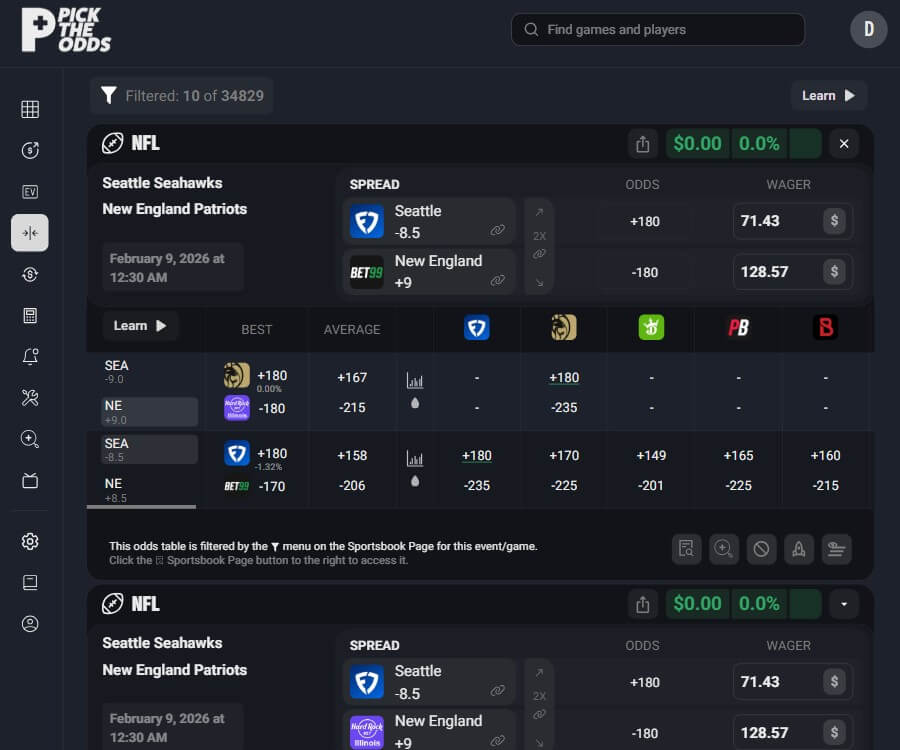
Ok, so how can you find a middles bet? Well, the first two steps are finding the middle itself and scanning sportsbooks for hedged betting opportunities.
- Scan sportsbook odds to look for profitable openings
- Research stats to find highly probable middles
There is no strict order to these steps, ideally you should be doing them simultaneously. But as both require plenty of research, you can’t really multitask and do them at the same time. So let’s start with finding the right odds – just as if you were looking for arbitrage bets.
Assessing Alternative Betting Lines
Scan the odds on totals lines and spreads lines at different sportsbooks. Try to gauge the average prices for each line, and take note of any big outliers or discrepancies. You are looking for mismatches, and ones that are big enough to make profitable hedged bets. This is easiest to do with an arbitrage betting calculator, as you don’t have to manually convert American Odds to Decimal, take the reciprocals for Implied Probability, and then add IPs to assess whether or not the odds are to your advantage.
But if you were to do it manually, the process is the following. Pick out contrasting bets, and convert the American Odds into Decimal Odds. For example, pairings of -110/+120 (example 1) and -200/+175 (example 2).
For favorite bets (negative numbers), the formula is: 100 / American Odds + 1
- Example 1 favorite becomes 100 / 110 + 1 = 1.91
- Example 2 favorite becomes 100/200 + 1 = 1.5
With underdog odds (plus sign numbers), the formula is: American Odds / 100 + 1
- Example 1 underdog odds becomes 120/100 + 1 = 2.2
- Example 2 underdog odds becomes 175 / 100 + 1 = 2.75
Then, you divide 1 by the decimal odds to get the reciprocal. For the underdog/favorite pairings of both examples, you are looking at:
- Example 1: 1/1.91 = 52.38% IP. 1/2.2 = 45.45%. Implied probabilities added = 97.83%. This means the odds have an ROI of +2.17%
- Example 2: 1/1.5 = 66.67% IP. 1/2.75 = 36.36%. Implied probabilities added = 103.03%. This means the odds have 3.03% juice – which converts to a ROI of -3.03%.
Calculating Stake Size and Hedging Bets
Example 2 is not a good middle, as the returns are negative if you only win 1 bet, but example 1, with an ROI of +2.17%, will work. You stake either side of the bet -110 (1.91) and +120 (2.2) with stakes that are proportionate to the odds, so that you get a balanced result regardless of which side wins. Again, a calculator will come handy here, but if you are doing it without, you need to divide the opposite decimal odds on each bet by the added total of the decimal odds.
- Bet 1 @ -110 (1.91) = 2.2 / 4.11. Stake = $53.53
- Bet 2 @ +120 (2.2) = 1.91 / 4.11. Stake = $46.47
And now what happens when either side wins:
- Bet 1 wins ($53.53 on -110) = $102.18 total returns. Net profit is $2.18
- Bet 2 wins ($46.47 on +120) = $102.23 total returns. Net profit is $2.23
- Both bets win = $204.41 total returns, of which the net profit is $104.41
The whole process is extremely time consuming if you are new to arbitrage betting, or don’t have software/betting calculators to do all the number crunching for you. There are three things you can do to make it easier.
- Build a spreadsheet (still requires manual data input, odds conversion, ROI calculation and stake weighing)
- Use betting calculators (only requires manual data inputs, automatically calculates the rest)
- Using a middles/arbitrage betting software (all data inputs and calculations are done manually)
Building spreadsheets require you to set up formulas and charts before checking the odds, but you only do this once. From there, you have to input all the data, and then plug the calculations into different cells to find out ROI potentials, stake sizing ratios, and so on. You save time if you use a hedged betting calculator, which will read the odds and give you stake sizing and ROI based on those odds, and your bankroll.
But the best is having betting software to do all of that for you. With betting software, the odds are automatically sourced (and not just from 2 or 3 books, but from all the top US sportsbooks), and your job is only to assess the middle itself – which we will go into now.
Finding the Middle
The goal of placing a middle is to hit the middle, you are not aiming to make ends meet by winning just 1 bet, but you want both to win. If you are just aiming to hit 1 bet, then you may as well close the middle and turn it into an arbitrage bet – the ROI will go up and you can settle for winning 1 bet – it is more profitable. So that is why you can’t choose an arbitrary number, or something unrealistic, you need to pick a line that has a very good chance of winning.
For instance, if you create an overlap of 6 goals for a soccer game (O 5.5 / U 6.5), you may find good hedged betting value, but the chances of a soccer game ending with 6 goals are very slim. The more common lines are 2 and 3, statistically speaking. Your line shouldn’t be unrealistically high or low, you need to assess Head to Head statistics, team goals/points/runs statistics, and form, among many other important figures. Make no mistake, predicting the exact middle is not easy and the majority of the time, you will not hit it.
So don’t get your hopes too high. But so long as you hit your middles every once in a while, it will make it worth it. That is, if the ROI and odds are right.
Middles VS Arbitrage ROI
Arbitrage bets will have a higher ROI than middles – in the event that you don’t hit the middle. Just consider a middles bet with a small overlap, and then adjust one of the hedge bets to close the line and increase the odds. The ROI will go up – but then the bet turns into an arb. While mathematically speaking, you will only hit a small percentage of your middles, if you are doing it right, then you should hit just enough to beat the larger ROIs on arbitrage bets in the long run.
To calculate this, we will give you a few examples. Please note, that in the table below, we have made a few assumptions:
- In that the middles/arb ROI percentage averages are consistent – 3% ROI over 10 results = 1.03^10
- The results are accumulative, after winning $103 from $100 we wagered $103 on the next bet
- For the middles bets we have taken the assumption that the two hedged bets are evenly matched – so for 1% ROI that means odds of 1.98 (-102) each and for 3% ROI odds of 2.06 (+106) each
- Only the last middle in the progression wins. So not your 1st bet in 10, but the 10th, 20th, 30th, etc win
| Middles vs Arbitrate Bets ROI | |||||
|---|---|---|---|---|---|
| Lower ROI Hedges | ROI (Middles Win Frequency) | Starting Bankroll | Bankroll After 10 Bets | Bankroll After 50 Bets | Bankroll After 100 Bets |
| Arbitrage Bets | 3% / Doesn’t Matter | $100 | $134.39 | $438.39 | $1,821.86 |
| Middles Bets | 1% (1 in 20) | $100 | $110.46 | W1 $120.81 x 1.98 = $239.20 W2 $288.95 x 1.98 = $572.18 $572.18 x 1.1046 = $632.03 | W3 $691.26 x 1.98 = $1,368.69 W4 $1,653.51 x 1.98 = $3,273.95 W5 $3,955.26 x 1.98 = $7,831.42 |
| Middles Bets | 1% (1 in 10) | $100 | W1 $109.36 x 1.98 = $216.53 | W2 $216.53 x 1.98 = $468.86 W3 $512.75 x 1.98 = $1,015.25 W4 $1,110.27 x 1.98 = $2,198.34 W5 $2,404.10 x 1.98= $4,760.13 | W6 $5,205.67 x 1.98= $10,307.23 W7 $11,271.99 x 1.98= $22,318.54 W8 $24,407.56 x 1.98= $48,326.97 W9 $52,850.37 x 1.98= $104,643.73 W10 $114,438.39 x 1.98= $226,588.01 |
| Higher ROI Hedges | ROI (Middles Win Frequency) | Starting Bankroll | Bankroll After 10 Bets | Bankroll After 50 Bets | Bankroll After 100 Bets |
| Arbitrage Bets | 5% | $100 | $162.89 | $1,146.74 | $13,150.12 |
| Middles Bets | 2% (1 in 20) | $100 | $134.39 | W1 $175.35 x 2.06 = $361.22 W2 $633.40 x 2.06 = $1,304.81 $1,304.81 x 1.3439 = $632.03 | W3 $2,287.98 x 2.06 = $4,713.23 W4 $8,264.66 x 2.06 = $17,025.19 W5 $29,853.67 x 2.06 = $61,498.56 |
| Middles Bets | 2% (1 in 10) | $100 | W1 $130.47 x 2.06 = $268.77 | W2 $350.66 x 2.06 = $722.36 W3 $942.47x 2.06 = $1,941.48 W4 $2,533.05 x 2.06 = $5,218.09 W5 $6,808.04 x 2.06= $14,024.57 | W6 $18,297.85 x 2.06= $37,693.57 W7 $49,178.80 x 2.06= $101,308.34 W8 $132,176.99 x 2.06= $282,284.59 W9 $355,249.70 x 2.06= $731,814.39 W10 $954,798.23 x 2.06= $1,966,884.36 |
Middles Betting Breakdown
Provided you have all your data: which bets you are picking, the sportsbooks you want to place them at, and how much you should stake on each wager, the process is extremely simple. You just sign into those sportsbooks, locate the wagers, enter your stakes, and confirm your bets. After that, there is nothing left to do but wait and hope that you will hit your middle.
You will need to have accounts at multiple sportsbooks, and that also means spreading out your bankroll accordingly. For the chart that we made above, we conveniently assumed that the ROIs always remain at the average levels (1% or 3%), and that your bankroll will grow evenly across your sportsbook accounts. In reality, you won’t get such convenience in your middles betting.
Be prepared to have differing results, books where your balance grows and others where you need to keep topping up. Hedging bets carries many risks, and spreading yourself out too thin is just one of them.
Important Knowhow for Middles Bets
If you ask the experts, there are definitely better sports, sharper books, more probable middles lines, and more layered strategies for taking advantage of middles. Learning a few of these tricks puts you a little ahead of the competition, but there is still lots of work to be done.
High Scoring, High Volatility Sports
The example with a soccer middles is really stretching the realms of fantasy, as soccer is very low scoring, and thus the potential outcomes are less volatile. It is very common to get 2 or 3 goals in a game, possibly extending to 0, 1, 4, and potentially 5. You only have 6 middles to pick from, and 2 of those are more realistic than the rest – generally speaking. Where the lines are more limited, so too is the ROI.
Compare that to NFL games, where scoring averages can easily range from 20 to 25, and that is without really stretching out to less likely outcomes like 15-20 or 25-30. Or, the best for middles betting, NBA games where the overall points per game can easily range from 210 to 230. The volatility is so high that even betting on team totals has a good 10+ potential lines that you can utilize.
With NBA games, you have bigger ranges, so you can afford to open your middles overlap a little, possibly extending to 2, 3 or even 4 lines. Of course, the wider you open the lines the less the overall ROI is (if only 1 bet wins), but you give yourself a larger sweet spot to hit. Closing that line gives better overall ROI, but reduces your already slim chances of landing a perfect middle.
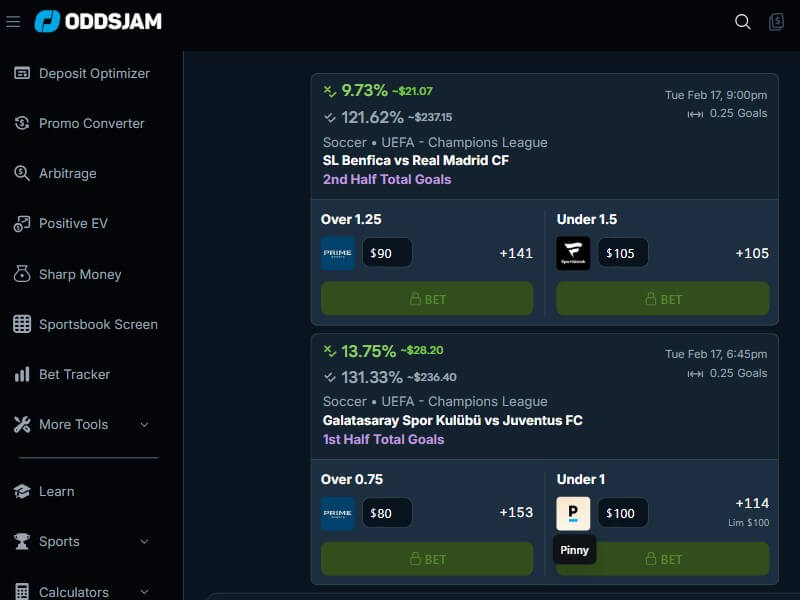
Look for Probable Lines
When you see a total points bet for a game, the official line is usually set at the midway point where the sportsbook sees an even chance of winning on over and unders. These lines are the most likely outcomes, according to the sportsbook, and the odds on Over and Under are around -110 each. If you are relying on their data alone, you can look for middles around the official betting line, comparing different lines and different sportsbooks and looking for any potential openings. Such as DraftKings puts the even money totals line at 23.5 points in an NFL game, but FanDuel sets their even money line at 22.5.
You stay around the official lines, like 22 or 23 points for that game, and look for sportsbooks with larger discrepancies around those lines. Or, you can do the statistical analysis yourself, and you may find that for the same game, the lines are probably going to be much lower, like say 19 or 20. In that case, you look for those lower lines and find the best priced odds based on your research.
How Big Should Your Overlap Be?
Bigger middles are easier to hit, so you get a better chance of winning both bets and securing a massive ROI from a single game. But as you open that line, the odds on either side of your bet reduce. That means, your ROI if only 1 bet wins becomes smaller. Finding the right balance is really up to you, some bettors even open the lines so much that they can only break even and cut their losses if they only win 1 bet. They are just playing for the middles, and don’t create an edge in the event that the middle doesn’t win.
You can open bigger overlaps on more volatile and high scoring sports, like basketball or even football. For soccer, basketball and other low scoring sports, you don’t have as many opportunities to make bigger overlaps. But you can get creative with your overlaps. In soccer, for example, instead of betting on total goals, you can bet on total corners – where ranges can span 7-12 or even lower/higher. For tennis, instead of betting on sets, look at total games, where there can be massive overlaps (based on the match format Best of 3 Sets or Best of 5 Sets). In UFC, look at total minutes instead of total rounds – you get the picture.
Where you can break up games or points into smaller denominations and extend the number of possible outcomes, there is greater opportunity to make higher ROI middles, and create larger overlaps (if you prefer them).
Timing Bets and Line Movements
Up until now, we have looked at middles as a one-dimensional hedged bet that you place at one point in time. There are no rules against placing the first leg of your hedged bet today, and the second right before the game starts, or during the game. Just like for arbitrage betting, if you play the time game and wait to hedge your bets, the potential for ROI can increase tremendously. But it comes with risks.
If the odds move away from your desired lines, then you miss out on your opportunity, and you cannot hedge your middles bet. You are basically hoping the public sentiment and betting probabilities will be impacted by external events before the game, and this has massive risks. However, if you are a CLV bettor, and experienced with typical line movements and patterns, it can be a natural extension to your strategy.
There are betting tools designed specifically to track line movements and gauge CLV percentages. They cannot predict the future – such as player injuries or weather impacts – but they can track historical line movements and make assumptions based on typical patterns and market averages.
Choosing Your Middles Betting Tool
When choosing your middles betting tools, think about the following:
- What sports you want to find middles for
- Which sportsbooks you use, and are they covered by the tool
- Do you need middles bet odds only – or require EV/stats research features too
- How much can you afford to spend on your middles tool
The last is very important – as there are massive differences between the affordable tools and the more advanced ones. Cheaper tools may have slower odds refresh rates, limited middles ROI, and cover fewer books. We also found a few that have basic in-built calculators and limited 1-click bet integration – meaning you lose precious seconds having to do these yourself.
More advanced tools tend to add these features to give you a more straightforward service. You delegate the calculations and act of finding the bet and adding it to your slip. Plus, they have sharper odds scanners so you don’t get middles odds that are minutes old (and may be already changed).
Don’t worry if you don’t know where to start – all middles betting tools have their own quirks and unique features. It’s best to get started by using our promo codes and links to get a free trial or discounted first subscription. That way, you can test the middles tool for yourself without splashing out, and can then decide whether or not the service meets your expectations or not.
