
When most people think of each-way betting, they think of placing a bet on an outsider in a big horse race such as the Grand National. Most punters use it as a type of insurance on big odds, hoping their £1 stake can return a tidy profit. However, few players approach each-way betting from a purely value perspective using tools and data, and they are missing out on many value betting opportunities.
This page will explain what each-way betting is, how to identify genuine value, and which tools to use. Each-way betting can help you reduce risk and play a huge part in your betting strategy if used correctly.
What is an Each-Way Bet?
An each-way bet is essentially two bets in one. If you are placing a win bet, your selection must win for you to claim a profit. On an each-way bet, you will also get a return if your horse finishes in 2nd, 3rd, or 4th place. For bigger races, some bookies now extend their payouts to 5th and 6th places. In fact, for the last Grand National, I saw some oddsmakers paying out for the top 8 positions.
Each-way means betting on two outcomes: that the horse will win, or that it will finish in the places. Consequently, your bet is made up of two parts: win and place. If you place a £5 each-way bet, the total stake will be £10, as you are staking £5 on the ‘win’ and £5 on the ‘place’.
The place portion of the bet is paid at a fraction of the win odds. You will typically get 1/5 odds on handicap races and 1/4 odds on smaller fields.
Tools for Each-Way Betting
The good news is there are tools that can identify where the each-way value is on races, doing all of the legwork for you. These tools have been designed to maximise profits by hedging and analysing two-part bets, as well as identifying discrepancies between bookmaker odds and betting exchanges for lay betting purposes.
OddsMonkey Each-Way Matcher
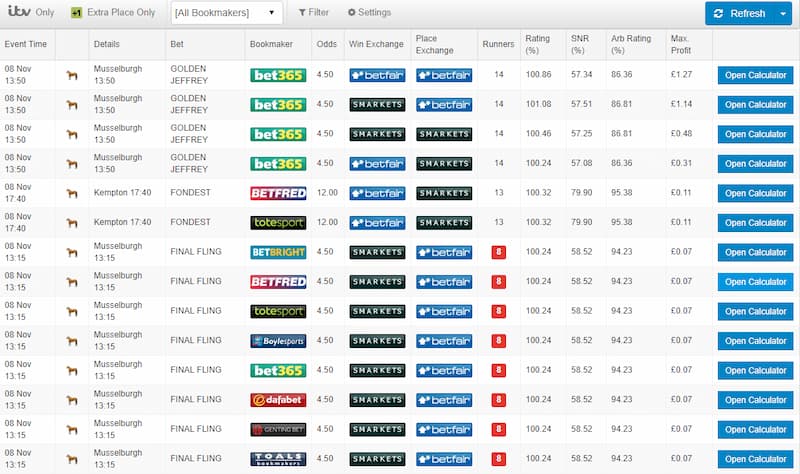
The OddsMonkey each-way matcher is an advanced tool that can help you make consistent profits. It analyses thousands of odds from over 50 bookmakers and compares these prices with win and place bets from betting exchanges. Although each-way betting is predominantly associated with horse racing, it can also be used on other sports, and this tool isn’t just restricted to horse racing betting.
OddsMonkey focuses on matched betting, and using each-way betting for matched betting purposes, you will need to place another bet on the betting exchange because you need to ‘match’ your each-way bets. It may sound like a convoluted process, but that is where the each-way matcher comes in. The tool simplifies everything by finding and analysing the best each-way odds quickly.
Users can filter the results to show only the horses they are interested in from a specific race, allowing them to determine if an extra-place race is profitable. You can use the each-way matcher on all races, not just the big national meetings.



Outplayed Each-Way Catcher
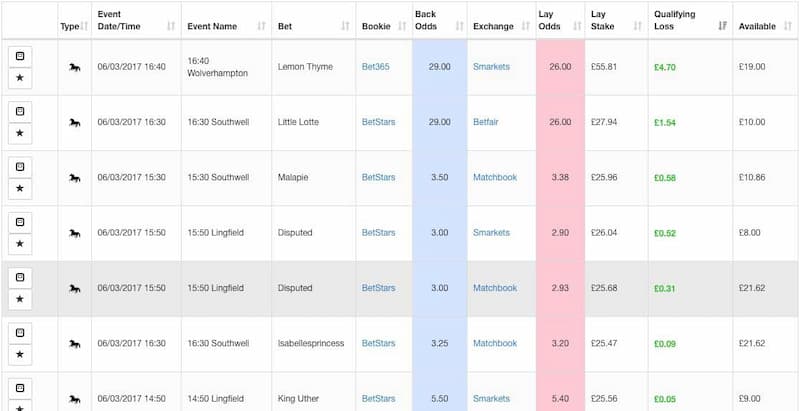
The Outplayed each-way betting catcher is an advanced matched betting tool that, just like the OddsMonkey version, compares odds on each-way bets between bookmakers and exchanges. This tool is a huge time saver as it automatically finds the best matched betting opportunities quickly, scanning thousands of prices so you don’t have to.
Users can filter the results by rating, time, bookie, extra place offers, or live TV races. There is also an integrated calculator that calculates your lay stakes for each-way bets. It is really easy to use, designed to handle the win and place parts of the bet. Once you have entered your stake amount, the calculator instantly provides accurate results.

Other Features for Each-Way Betting
OddsMonkey and Outplayed are excellent tools if matched betting is part of your each-way betting strategy. There are some other important features and tools that can help ensure your each-way bets are successful.
Odds Comparison Software
Comparing odds across multiple bookies is vital to find the best prices for your each-way bets. Look for tools that have price comparison APIs that can do all of this work for you in seconds. The goal here is to find the best win and place odds available. Any edge you can get is worthwhile, and software like this is also really simple to use.
Betting Exchanges
Betting exchanges such as the Betfair exchange gives you a lot of vital information. Using an exchange will show the market probability of both your win and place bets, and also provide a market efficiency benchmark. You can use a betting exchange to determine whether the bookmaker’s odds are mispriced, and if so, you can jump on the opportunity.
Each-Way Calculators
Each-way calculators calculate the exact return you can expect for both the win and place parts of your bet. These results are based on the odds, total stake, place term, and the number of places paid. Some sites will have in-built calculators, while some will offer this tool as a standalone feature.
Probability Modelling Tools
These are for more advanced or professional bettors. There are different things you can do for modelling purposes, from Excel Monte Carlo simulations to using racing databases and even Racing Post ratings. The main purpose of your model is to estimate realistic win and place distributions.
Tips for Each-Way Betting
There are lots of common misconceptions out there surrounding each-way betting, and also things to avoid if you want to have a successful each-way betting strategy. For example, most people believe each-way is a ‘safer’ bet, and inherently feel more relaxed than if they were to place a win bet. However, each-way betting is only profitable long-term if the place odds are underpriced by the bookmaker and the placed probability is higher than the implied probability. If there is no value, an each-way bet isn’t worthwhile.
Some tips to consider when placing an each-way bet include:
- Look for large fields; more horses means more variance and a higher likelihood of mispricing.
- Look for bookmakers that offer extra places, instead of paying out on the top 6; some go as high as the top 8.
- High prices mean the place portion becomes very strong, giving you a higher potential payout.
There are also things you should avoid when placing each-way bets. The most obvious one is betting on the clear favourite, as you won’t make much back at all from an each-way bet unless it wins, which defeats the object. We would also say don’t just bet each-way blindly on a small field. Horse racing is difficult, and betting on smaller fields requires lots of research into the form of the horses, weather conditions, ratings, etc.
Understanding Value in Each-Way Betting
To find out the true value, you must compare the bookmaker’s place odds with the place probability. You need to convert the odds to implied probability, and there are many free odds converter calculators available for you to do that. Then you can use tools to estimate the place probability.
The most common method is to convert exchange win odds into probabilities and then estimate place probability. You could use Betfair place markets if they are available to gain an idea of the true price.
Summary
Each-way betting has long been considered a type of safety blanket in the betting world. While it does give you more chances of winning than a straight win bet, you will only be successful if you stay consistent. You need to perform certain actions, such as comparing markets, tracking results, calculating expected value, and considering probabilities.
That may sound complex, but there are tools that can help you carry out those tasks and more. If you use the right tools effectively, each-way betting can turn from a risk-averse, safety option to a more structured strategy. Just always remember that the edge is in the price and not the bet type.
