
Betting odds are at the center of all your sports wagers, and understanding how they work is integral to learning how to spot the difference between a good deal and an overinflated price. Anyone who hasn’t bet on sports before may take some adjusting to the main screen on a sportsbook, filled with different types of betting markets and numbers, sort of like a data spreadsheet or those old fashioned pink sheets for stock trading.
You can learn how to read these odds screens in a matter of seconds, but there are lots of tricks to identifying the good opportunities and weighing up different bets to find the best value for your money. Betting odds can be displayed in three different formats, Decimal Odds, American Odds and Fractional Odds, all of which show the same numbers but slightly differently. There are pros and cons to using each, and on this page we will run through all the basics so you know how to read them effortlessly.
How To Read American Odds
American odds are displayed to show you the favorites and underdogs. The odds are displayed in three digit numbers or larger, with a plus sign (for underdogs) or a negative sign (for favorites) in front of them. They are based on how much money you stand to win for every $100 placed on an underdog bet, or with the favorites, how much money you need to stake to win $100.
For example, take a favorite bet with odds of -150, you will need to place $150 to win $100. Your stake will be returned if you win the bet, so you will receive a total return of $250. For an underdog priced at +150, you can place $100 to win $150. If you place the same money, $150, on that bet, you stand to win $125 in profit and receive your stake of $150 back, meaning a total return of $375.
Of course, you don’t have to bet in denominations of $100; you can bet with as little as your sportsbook allows. At the top US sportsbooks like DraftKings, the minimum you can bet is a single dollar. The important thing to remember here is that the American Odds are designed to show you the Net Profit. We will get back to that a little later when we have covered the other types of odds.
Other Odds Formats
At the biggest US sportsbooks and betting platforms, you will have the option to switch from American Odds to Decimal. These are the two most widely used betting odds formats in America. To switch from one format to the other, you can change your odds display preferences.
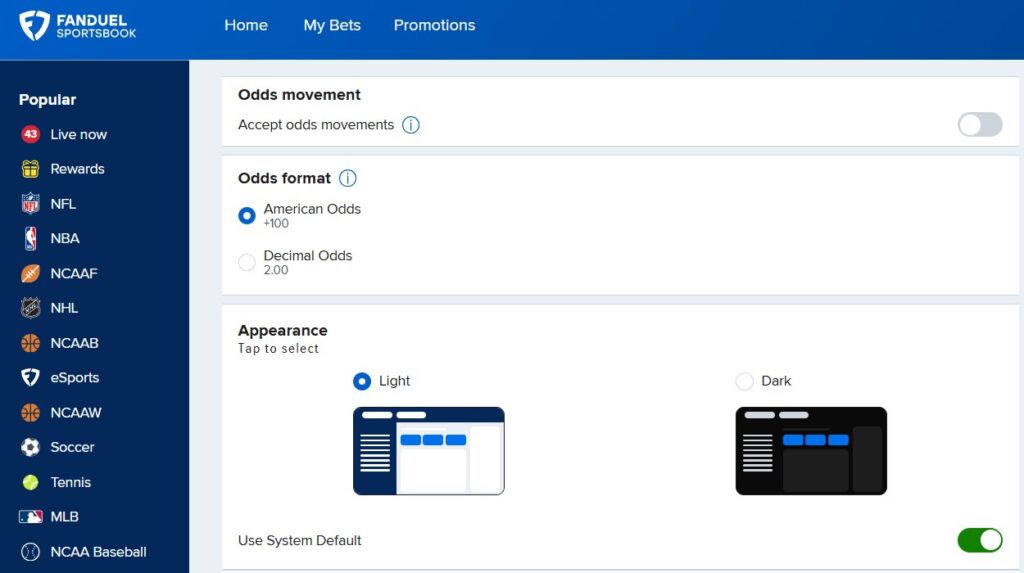
Decimal Odds
These are the default odds format across Europe and many US sports bettors have adopted Decimal Odds for being easier to calculate probabilities and parlay betting odds from. The main difference between Decimal Odds and American Odds is that with decimal odds, you can simply multiply the odds by your stake to calculate your Gross Profit. There are no denominations of 100 to factor into the equation, plus you don’t need to get the reciprocal of the favorite bets (American odds on favorites display how much you need to stake to win $100, not how much you win off $100).
There are no obvious distinctions between favorites and underdogs in Decimal Odds, you don’t have positive and negative signs in front of the odds. The trick to spotting a favorite bet from an underdog is the following:
- Favorites have odds of less than 2
- Underdogs odds start from 2 and go up
For example, a bet of 1.5 is a favorite bet, and to calculate how much you stand to win, simply multiply 1.5 by your stake. A bet of $10 stands to win $15 in total – including your staked money.
A lot of bettors find it easier to use Decimal Odds because it calculates Gross Profit, not Net Profit.
Fractional Odds
Fractional odds are popular in the UK, and these are a classic odds format. Like American Odds, they only show the Net Profit, so you may get a bet of 1/2 and this will win $15 from a $10 bet. The 1/2 is multiplied against your stake, and then to calculate the total returns, you add your stake.
While a popular format in the UK, this is perhaps the most difficult odds format to use. You can find odds such as 6/17 or even integer mixed fractions such as 3.5/5.
Hong Kong Odds (AKA Net European Odds)
This is a very rare type of odds format, and unless you travel to Asia there is a good chance you will never encounter it. Basically, it is the same as the European Decimal Odds, but instead of showing you the Gross Profit, you get Net Profit.
Therefore, a Decimal Odds bet of 1.5 will be shown as 0.5. You can calculate your net profit by multiplying your stake against the Hong Kong Odds, but to get the full return, you have to add your staked money afterwards.
Implied Probability
Mathematically, implied probability is the reciprocal of the decimal betting odds, and this converts into a percentage – the percentage of your bet winning as implied by the betting odds. In mathematics, we display probabilities as fractions, but for sports betting purposes, these are converted to percentages.
There are two different types of probability percentages:
- Implied Probability: The chance of your bet winning as indicated by the odds
- Expected Value: The “actual” chance of your bet winning
The difference here being that the betting odds will generally have juice, and so the implied probability of your bet winning is often a little higher than what the sportsbooks actually reckon it is. To prove it, look at two sides of a point spread bet. If they are priced at -110 each, then the IP for either is 52.38%, which adds up to 104.76%. The remaining 4.76% of the IP is the juice, or the house edge.
Expected value, on the other hand, is the real probability of your bet winning. If you measure the EV and it is LOWER than the IP, like 65% EV (-186) and the IP is 70% (-233), then you have a positive value bet.
Sportsbooks will not show the IP, nor give you their estimated EV. Instead, you can calculate the IP yourself or use betting calculators. For EV, you can use your gut instinct, but there are lots of betting tools out there that use data driven algorithms to give you exact EV percentages. Using these, you can gauge the actual probabilities with what the sportsbooks are offering. But remember, it is a theoretical science, there are no algorithms or AI powered software that can see the future, they can only predict what may happen based on the offered odds, statistical analysis, and other data points.
Prediction Market Odds
Prediction markets have become a massive hit in America, and these peer betting platforms have a completely different format for showing you the odds. In fact, they don’t even give you betting odds, but implied winning probabilities instead.
You have to buy contracts for yes/no markets, and for every contract you buy, you get paid $1, barring any commissions or trading fees. The price of the contract is the implied probability of the bet winning. So a $0.40 contract has a 40% implied probability of winning. A contract that costs 75 cents has a 75% chance of winning, as implied by the platform.
Pros and Cons of Each Odds Format
Learning to read the odds doesn’t take much time at all, and you can adjust to any of the formats with enough time. There are pros and cons to each betting odds format, but truthfully speaking, it is more of a personal choice than anything else. If you learn to read fractional odds quickly, you may find that format more comfortable to use than the others.
A bettor who uses Decimal Odds for years can adapt to American Odds and learn how to analyze them in the same amount of time. As can an American Odds bettor who makes the jump to Decimal Odds. Below, we have summarized some of the most important points to notice about each of the odds formats.
| Understanding Odds Format Differences | |||
|---|---|---|---|
| Odds Type | Where It Is Used | What It Shows | How to Read Favorite vs Underdog |
| American | US, and CA | Net Profit | Favorite: – sign Underdog: + sign |
| Decimal | EU, AU, CA, and US | Gross Profit | Favorite: <1.99 Underdog: >2.0 |
| Fractional | UK | Net Profit | Favorite: <1/1 Underdog: >1/1 |
| Hong Kong | Asia | Gross Profit | Favorite: <0.99 Underdog: >1.0 |
| Prediction Market Odds | US | Implied Probability | Favorite: >50% Underdog: <49.9% |
For math driven betting strategies, Decimal Odds tend to be the quickest and most efficient. It is just that much easier to calculate parlay odds or get the IP and resulting juice from Decimal Odds than it is when using American Odds.
How to Convert American Odds
To get the Implied Probability from American Odds, you would need to convert them first into Decimal Odds. The process is made a little more complex as American Odds use Net Profit instead of Gross, which we will have to add to formulas.
There are two formulas that are needed to convert American Odds to Decimal Odds. One is for favorite bets and the other is for underdog bets. Converting underdog bets is slightly easier, so we will start there.
Converting American to Decimal: Underdogs
[American Odds + 100] / 100 = Decimal Odds
It is simple for the underdog as you first add 100 to include the stake in the odds (Net Profit to Gross Profit), and then divide by 100 units to get the Decimal Odds integer.
Converting American to Decimal: Favorites
[100 / American Odds] + 1 = Decimal Odds
As all favorite odds (plus sign odds) are based on “how much you need to stake to win $100” rather than “how much you win off $100”, you need to divide 100 by the odds to get the win multiplier odds. However, it still just counts the Net Profit this way, so you have to add 1, representing the stake, and this will give you the Decimal Odds.
The process is a lot easier with American odds betting calculators, where you can gain the decimal odds instantly, making it more efficient to compare alternative lines and calculate IP.
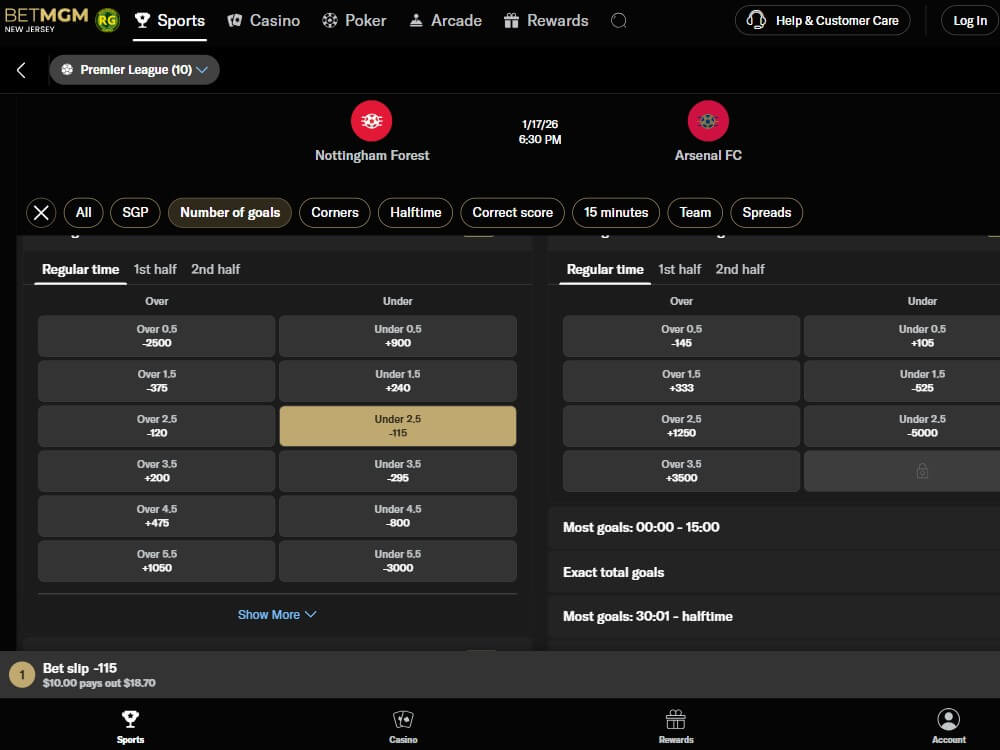
Where Different Odds Formats Are Useful
Sports betting doesn’t just stop at reading odds. The more advanced betting strategies like value betting, kelly criterion, matched betting and hedged betting all require a deeper analysis of the odds. Even with calculating your parlay bets or SGPs, some of the odds formats are just quicker and easier to use.
Spotting Juice/Vigorish
Juice is tiny percentage that sportsbooks skim off the odds to get a cut from your sports bets. As you don’t pay to make deposits, there are no registration fees, and you aren’t paying the sportsbook to make deposits (at the top US sportsbooks, some blacklisted books may have these conditions), the sportsbook needs to make its business. So shaving off a fraction of your potential returns is the way they do it, and this give them a slight house edge.
It is almost impossible to see the juice with the naked eye, you have to calculate the IP to gain this information. The best odds for getting the implied probability are decimal odds, and this makes it the best format for calculating juice. You just divide 1 by the decimal odds, and you will get the IP. Then, add the implied probabilities on both sides of a betting line (or all three for 3-way betting markets), and the remaining % above 100% is the juice.
For example, moneyline odds of 2.8 and 1.46. The implied probabilities of these are 35.7% and 68.5%, respectively. The sum of the implied probabilities is 104.2%, and so the juice is 4.2%. To calculate the juice with American Odds, you have to convert them into Decimal Odds first.
Best Odds Format: Decimal
Calculating Implied Probability
And, unsurprisingly, it makes Decimal Odds ideal for calculating the implied probabilities on your wagers. From a mathematical standpoint, American Odds are actually the worst to calculate IP, and thus juice. Even fractional odds are slightly easier than American Odds. To calculate the IP from fractional odds, you can simply follow this formula:
Denominator / (Numerator + Denominator)
This is because you need to calculate the reciprocal odds (1 divided by Decimal Odds). You flip the fraction upside down, but remember Fractional Odds do not count the Gross Profit but Net Profit. So, just make sure you add 1 to the fractional odds before flipping the fraction. In simpler terms, add the denominator number to the numerator number, and then flip the fraction upside down.
For example, take odds of 6/5 or a point spread of 10/11. In the first case (6/5), you have to calculate this fraction: 5/11 = 45.45%. In the second case (10/11, which is the same as -110 or 1.91), you have to calculate this: 11/21 = 52.38%.
American Odds have different calculations based on whether the odds is negative or positive, and they must be converted to decimal odds to get the IPs.
Best Odds Format: Decimal
Parlay and SGP Betting
Decimal Odds wins again, as parlay and SGP betting is a lot more straightforward. You just need to multiply the Decimal Odds from all your selections against each other. For example, if you have three bets at odds of 1.9, 2.1 and 1.5, you simply multiply: 1.9 x 2.1 x 1.5 = 5.985. With simpler numbers, such as odds of 2, 2 and 4, you can even do it in your head (16x). So you can more or less assemble your parlays with an aim for specific odds or numbers of legs, and do all the mathematics in a matter of seconds.
With American Odds, you can’t simply multiply the odds against each other. For one, they don’t include the stake (Net Profit not Gross Profit), without which you won’t get the parlay odds. Say you have only underdog bets, add 100 to include the stake, and then multiply them against each other. Odds of +250 and +110 would become +350 and +210, respectively, and the corresponding multiplication would result in +73,500. Those are NOT your parlay odds, the actual odds are +735, because you need to divide the American Odds by 100 (standard units), and then multiply the resulting parlay odds (3.5 x 2.1 = 7.35) by 100. So 7.35 x 100 = +735. But within that process, we have already converted the American Odds to Decimal Odds and then back again.
So, for parlays, SGPs, and other multiples bets, Decimal Odds emerge as the best format for quick arithmetics.
Best Odds Format: Decimal
Hedged Betting
Closing up, we have hegded betting. This is a betting strategy in which American Odds beat Decimal Odds, as the formula perfectly mirrors the Back/Lay formula. When hedging your bets, the idea is to find a pair of odds which are priced so that you are breaking even or making a slight profit. You are beating the house because you choose odds where the discrepancies rule out the juice.
To cut to the chase, with American Odds you simply need to reverse the positive/negative sign, and find odds at those prices to break even. For example, you bet on odds of +210, -150, or +600, you need to look for odds of -210, +150, and -600. To reach $0 in Gross, you must place the Net Profit returns you would get on those initial bets on the opposing lines.
- Betting $10 @ +210 means you will get $31 ($21 + $10). You place a lay bet of $21 on odds of -210, which will win $31 ($10 + $21)
- Betting $10 @ -150 means you will get $16.67 ($6.67 + $10). You place a lay bet of $6.67 on odds of +150, which will win $16.67 ($10 + $6.67)
- Betting $10 @ +600 means you will get $70 ($60 + $10). You place a lay bet of $60 on odds of -600, which will win $70 ($10 + $60)
No hedged bettor wants to place bets to reach $0 profit; you want to lay a bet that will make a profit regardless of the outcome of the game. But this is a good starting point for your hedged bets. Basically, place Bet #1 and then look for a sportsbook that gives Bet #2 with odds that are better than the Additive Inverse (this is when you use the other sign, the additive inverse of +120 is -120).
You don’t get that convenience with any of the other odds formats, as these don’t have formulas depending on whether the odds are favorites or underdogs, which gives American Odds bettors a unique advantage when hedged betting.
Best Odds Format: American
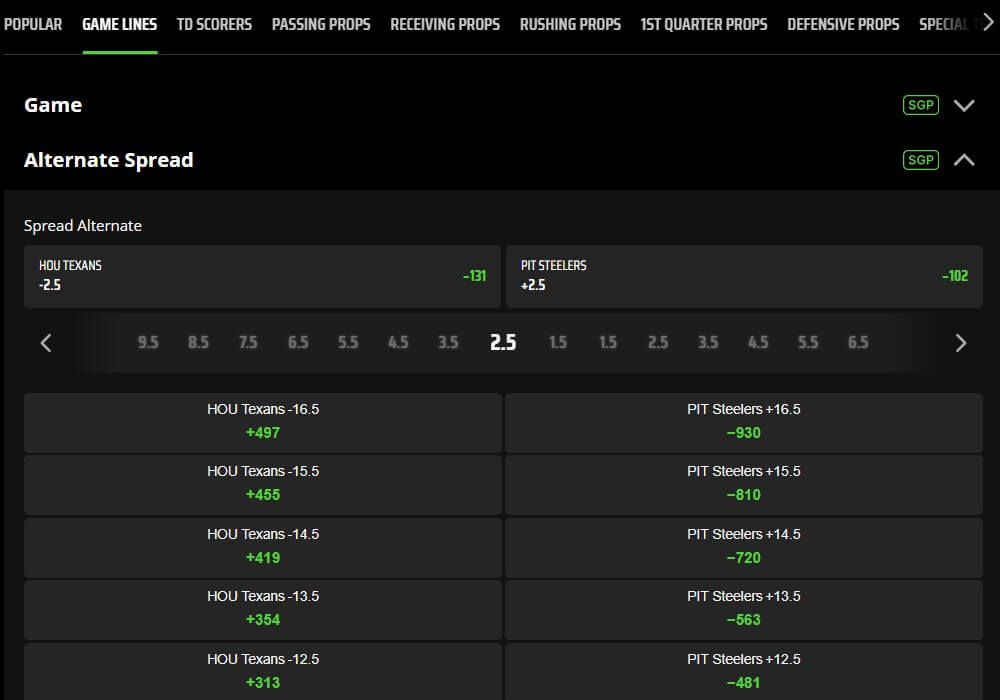
US Sportsbooks with Highest Quality Odds
Betting odds and quality of betting lines are the biggest selling points of any sportsbook. US bettors have a great choice of sportsbooks, social sportsbooks, peer to peer betting apps and fantasy betting apps to pick from, and this broad competition only drives down juice and enhances the quality of what bettors in the US get.
All sportsbooks want to beat the competition with their bonuses and betting odds, and even if that edge is just a matter of cents, it can make all the difference for value seekers. We have reviewed countless worthy US sportsbooks, and a few betting sites that are best avoided, as detailed in our blacklisted betting sites page. Below are the sportsbooks that we can whole heartedly recommend – you will definitely recognize a few, if not all, as these are among the biggest and most competitive books in the US. And for good reason.